1. Demystifying Non-Isolated POL Converters in Modern Power Architectures
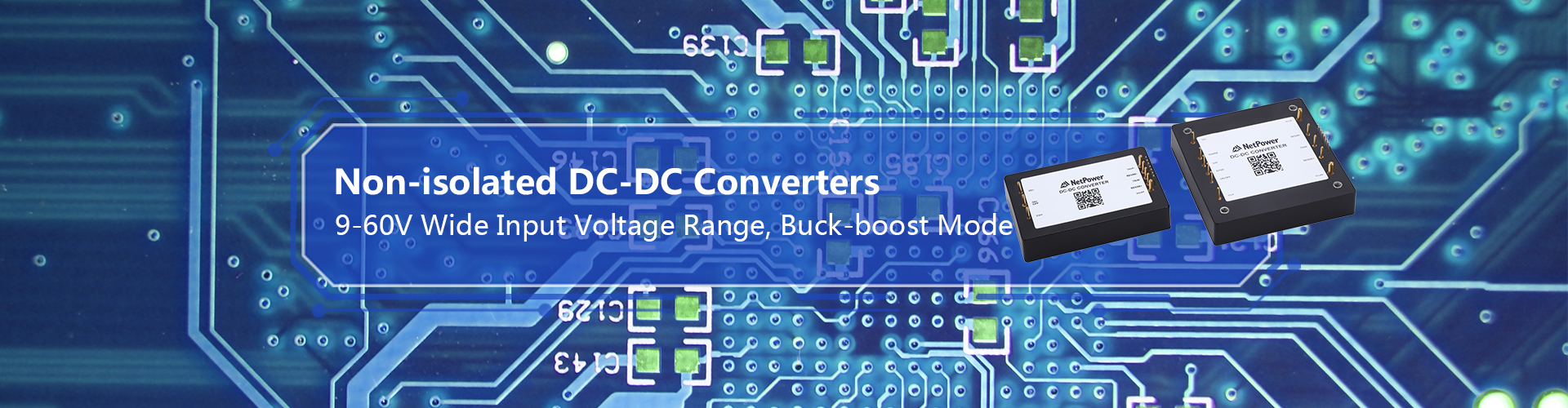
In modern electronic hardware design, the shift from centralized power conversion to Distributed Power Architecture (DPA) and Intermediate Bus Architecture (IBA) has made Non-Isolated Point-of-Load (POL) Converters an essential building block. Unlike traditional isolated DC-DC converters—which utilize isolation transformers to electrically separate input and output grounds—non-isolated POL converters function as high-performance step-down buck regulators placed physically adjacent to the load (microprocessors, FPGAs, ASICs, or DSPs).
By eliminating bulky galvanic isolation components, non-isolated POL modules deliver unprecedented power density, volumetric efficiency, and rapid transient loop response. In intermediate bus architectures, a primary isolated converter steps down high line voltages (such as 48V telecom or 220V AC systems) to an intermediate rail—typically 12V, 5V, or 3.3V. The non-isolated POL converter then performs the final step-down to low Vcore voltages ranging from 0.6V to 3.3V at continuous current levels frequently exceeding 50A to 100A.
Key Takeaway for Sourcing Teams:
Placing non-isolated POL converters within millimeters of high-speed processors minimizes trace resistance ($R_{trace}$) and parasitic inductance ($L_{trace}$). This prevents severe voltage drops ($I \cdot R$) and transient inductive spikes ($L \cdot \frac{di}{dt}$) during rapid processor power-state transitions.
2. Critical Engineering Evaluation Criteria for Global Procurement Teams
When procurement managers and hardware architects evaluate non-isolated POL converters from global manufacturers, looking strictly at headline cost or nominal power output is insufficient. Search intent analysis across enterprise hardware teams reveals four non-negotiable selection vectors:
A. Transient Response & Dynamic Voltage Tolerances
Modern AI accelerators and high-density FPGAs exhibit aggressive load step dynamics, transitioning from idle to maximum current draw in nanoseconds ($\frac{di}{dt} > 100A/\mu s$). Non-isolated POL converters must maintain output voltage deviation within extremely tight margins (often $\pm 1\%$ to $\pm 3\%$). Key specs to scrutinize include:
- Peak Over/Under-shoot Voltage: Deviations during $50\%$ to $100\%$ load step.
- Recovery Time: The duration required for output voltage to settle back within nominal regulation window (typically $< 10\mu s$ in high-grade NetPower POL regulators).
- Output Capacitor Bank Reduction: High bandwidth control loops reduce the required external bulk capacitance, saving PCB area and bill-of-materials (BOM) cost.
B. DOSA Standardization & Second-Sourcing Risk Mitigation
Global component shortages have reinforced the necessity of dual-sourcing strategies. The Distributed-power Open Standards Alliance (DOSA) establishes standardized mechanical dimensions, pin configurations, and control features for non-isolated POL converters. Sourcing DOSA-compliant POL modules from NetPower guarantees:
- Direct footprint compatibility across SMT and through-hole packaging options.
- Zero PCB layout redesign when cross-listing alternative vendors.
- Standardized pin functions: $V_{in}$, $V_{out}$, $GND$, $Trim$, $Enable/Sense$, and $PGOOD$.
C. Thermal Derating and Real-World Power Density
A non-isolated POL converter rated for 40A on paper may only deliver 22A in an ambient environment of 65°C without active airflow. Superior POL manufacturers publish clear thermal derating curves under varying airflow velocities (0 LFM to 400 LFM) and baseplate mounting conditions. NetPower incorporates high thermal conductivity substrate materials and optimal FET layouts to maximize convection cooling efficiency.
| Converter Parameter | Standard Discrete Buck Design | NetPower DOSA POL Module | Procurement Impact |
| Board Footprint | Large (Multiple passive ICs) | Ultra-Compact (Integrated) | Saves up to 60% PCB surface space |
| Development Time | 6 – 9 Months (Loop tuning required) | Drop-In / Plug-and-Play | Accelerates Time-to-Market (TTM) |
| Compliance & EMI | High risk of layout oscillation | Pre-tested CISPR32 Class B | Reduces qualification testing costs |
| Thermal Management | Localized hot spots on PCB | Distributed substrate heat spreader | Extends system MTBF and field service life |
3. Emerging Procurement & Technology Trends in POL Converters (2025–2030)
As next-generation computing, autonomous vehicles, and industrial automation mature, the technical requirements governing non-isolated POL converters are undergoing rapid evolution. Procurement teams must anticipate the following industry trends:
Trend 1: Migration from 12V to 48V Direct-to-POL Architectures
In data centers powering Artificial Intelligence (AI) and Machine Learning (ML) workloads, distribution losses across traditional 12V backplanes have become unsustainable ($P_{loss} = I^2 R$). Consequently, hyper-scale data center architects are adopting 48V Intermediate Bus Architectures. Next-generation non-isolated POL converters are now required to operate across wide input ranges (up to 60V continuous), stepping down 48V directly to sub-2V processor cores in a single high-efficiency stage.
Trend 2: Wide Bandgap Semiconductors (GaN & SiC Integration)
Silicon MOSFETs are reaching their physical switching frequency limits. Advanced non-isolated POL converters are increasingly incorporating Gallium Nitride (GaN) power transistors. GaN enables switching frequencies well above 1 MHz to 3 MHz, dramatically reducing the size of internal energy storage inductors and output capacitors while boosting conversion efficiencies past 97%.
Trend 3: Digital Power Management & PMBus 1.3 Telemetry
Modern system control architectures demand real-time diagnostics. Non-isolated POL converters equipped with PMBus digital control interfaces allow system controllers to dynamically adjust output voltages (Dynamic Voltage Scaling - DVS), read real-time load currents, monitor operating temperatures, and log fault flags before failure occurs. This capability is paramount for predictive maintenance in mission-critical servers and industrial automation networks.
4. Corporate Strengths: Why OEM Engineers Specify NetPower Non-Isolated POL Modules
When selecting a manufacturing partner for critical power conversion components, global purchasing organizations look beyond basic specs to evaluate company stability, quality management systems, and technical responsiveness. NetPower Technologies stands at the forefront of switch-mode power conversion, backed by unique corporate strengths:
Uncompromised Design-for-Reliability (DfR)
NetPower applies a documented, rigorous quality system across every step of design and production. Every non-isolated POL module undergoes component derating analysis, thermal stress simulation, dynamic load loop verification, and Highly Accelerated Life Testing (HALT).
100% Automated Testing & Full Traceability
Unlike suppliers relying on sample testing, NetPower subjects 100% of finished converter modules to automated functional screening and thermal burn-in testing. Serial numbers provide complete material traceability from semiconductor wafer lot to final system installation.
Direct Access to Power Engineering Specialists
Sourcing power modules from NetPower means immediate access to experienced power design engineers. Whether you need layout optimization feedback for high-current POL ground planes, assistance configuring PMBus telemetry parameters, or semi-custom mechanical adaptations, our technical team works directly with your hardware developers.