Comprehensive Technical Guide: EV On-Board DC-DC Converter Selection & Architecture
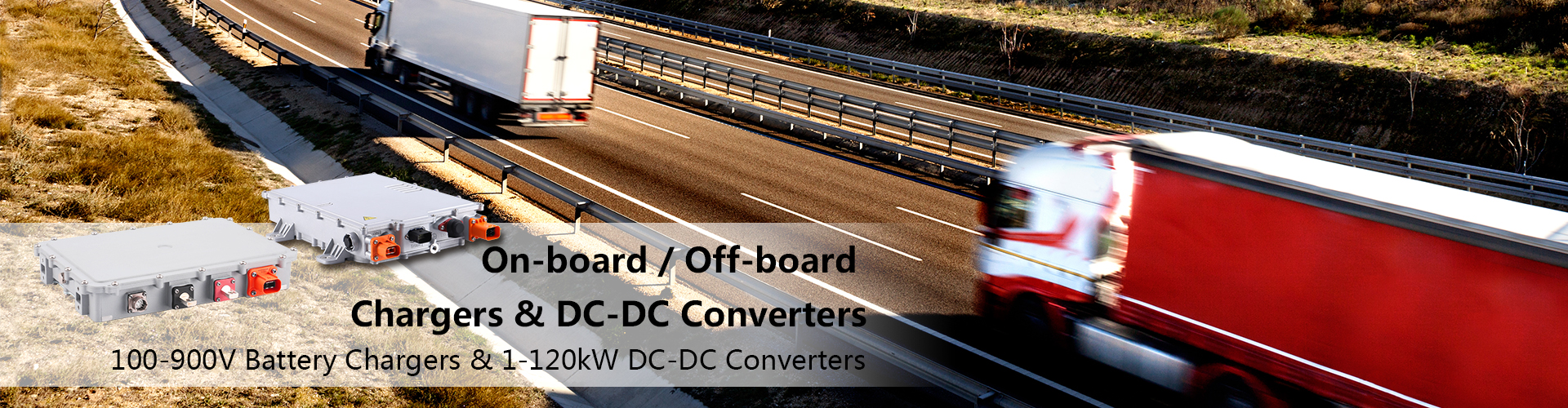
Selecting the optimal EV On-board DC-DC Converter is a critical engineering decision in modern electric powertrain development. Whether designing an 800V commercial haulage truck, an electric transit bus, an agricultural tractor, or a passenger electric vehicle, the auxiliary DC-DC system directly governs vehicle safety, battery utilization efficiency, and thermal management complexity.
Key Architectural Considerations for High-Voltage EV DC-DC Conversion
When migrating from legacy 400V architecture to modern 800V battery buses, power engineers face significant design challenges related to high voltage stress, isolation distance requirements, and switching loss mitigation. Standard hard-switching topologies suffer unacceptable switching losses at elevated voltages. Consequently, high-performance EV DC-DC converters rely on advanced soft-switching topologies:
- Phase-Shifted Full-Bridge (PSFB) Converters: Ideal for high-power output applications, PSFB topologies utilize Zero Voltage Switching (ZVS) on the primary bridge switches to minimize turn-on losses across wide load variations.
- LLC Resonant Converters: Offering complete ZVS for primary MOSFETs and Zero Current Switching (ZCS) for secondary rectifier diodes, LLC resonant architectures operate efficiently across tight input voltage ranges, yielding peak conversion efficiencies exceeding 96.5%.
- Bi-Directional DC-DC Topologies: Modern vehicle-to-grid (V2G) and vehicle-to-load (V2L) systems increasingly utilize dual-active-bridge (DAB) topologies to allow power to flow bidirectionally between the high-voltage battery and auxiliary storage systems.
Thermal Management Strategies: Conduction vs. Liquid Cooling
Power density in automotive power electronics is strictly governed by heat dissipation capabilities. As converter power ratings increase from 1kW to 5kW+, the mechanical cooling interface dictates physical sizing:
Conduction/Baseplate Cooling: Recommended for low-to-medium power units (1kW to 3kW) or vehicles lacking secondary liquid cooling loops. Heat is transferred via direct mechanical contact from the converter’s flat aluminium baseplate to the vehicle’s cold plate or metallic chassis frame. High thermal conductivity potting compounds fill internal air gaps to ensure uniform heat distribution and eliminate hot spots.
Direct Liquid Cooling: Mandatory for ultra-high-density systems (3kW to 5kW+). Liquid cooling channels integrated directly into the converter enclosure circulate ethylene-glycol/water mixtures (50/50 ratio) directly beneath high-dissipation components such as SiC switches and planar transformers. This approach maintains operating junction temperatures far below maximum limits, guaranteeing extended MTBF under heavy continuous loads.
Evaluating Quality, Reliability, and Supply Chain Security
Automotive supply chains require rigorous component qualification and supplier transparency. NetPower Technologies applies strict Design for Reliability (DfR) methodologies, combining worst-case circuit analysis, stress derating (ensuring power semiconductors operate below 70% of maximum voltage/current limits), and finite element thermal simulation. Supported by isolated DC-DC converter technology, non-isolated POL modules, and custom power conversion platforms, NetPower is your authoritative technical partner for e-mobility transformation.