
Engineered for extreme thermal endurance, IP67 ingress protection, high efficiency (>96%), and strict CAN BUS digital integration required by Indonesian industrial and transportation OEMs.
The rapidly evolving industrial landscape of the Greater Jakarta area—spanning Special Capital Region of Jakarta, Bekasi, Cikarang, Karawang, Tangerang, and Depok—presents a highly demanding environment for electrical power conversion. As Indonesia accelerates its national electrification roadmap (Presidential Regulation No. 55/2019) and transitions heavy industrial zones, public transport fleets (such as TransJakarta), and commercial logistics to electric power, finding a qualified step converter supplier & suppliers in the Jakarta market has become a mission-critical strategic priority for system integrators, OEMs, and plant maintenance directors.
In power electronics terminology, a step converter encompasses both DC-DC step-down (Buck) converters, DC-DC step-up (Boost) converters, buck-boost topologies, and high-voltage isolated power modules. These devices serve as the vital bridge between primary high-voltage energy storage systems (such as 300V-650V traction battery packs, 48V telecom bus banks, or 24V industrial power supplies) and sensitive low-voltage control electronics (12V, 5V, 3.3V, 1.8V logic rails).
Deploying standard commercial-grade step converters in the Jabodetabek industrial belt frequently leads to premature operational failure. Localized engineering analysis reveals three primary stress drivers unique to the Jakarta market: Tropical Thermal De-rating due to ambient temperatures frequently exceeding 38°C with >85% relative humidity; Severe PLN Grid Voltage Harmonics & Transient Voltage Spikes; and intense mechanical vibration encountered during urban commercial transit and heavy manufacturing operations.
To ensure system longevity and strict compliance with Indonesian National Standards (SNI) and International Electrotechnical Commission (IEC) benchmarks, procurement managers must evaluate step converters across four primary topological classifications:
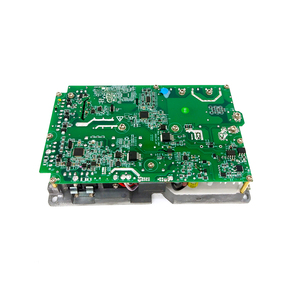
Utilizing half-brick, quarter-brick, and 1/16th brick standard footprints (DOSA compliant). Designed to step down 48V, 110V, or 300V bus voltages to isolated 12V or 24V auxiliary outputs with galvanic isolation up to 2250 VDC, protecting downstream microcontrollers from common-mode noise.
High-density step-down buck regulators accepting wide inputs (2.5V to 60V) designed to deliver high output currents (up to 100A) at exact logic levels (1.0V to 3.3V) for edge-computing FPGAs, PLCs, and telecom processors deployed in automated factories in Cikarang.
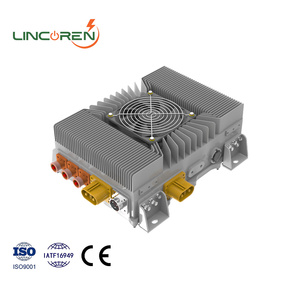
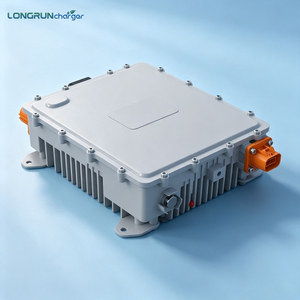
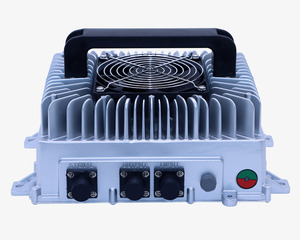
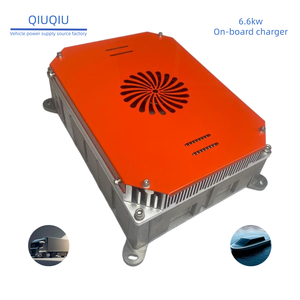
Combines a 3.3kW/6.6kW On-Board Charger (OBC) with an integrated 1.8kW/2.5kW bidirectional high-to-low voltage step converter. Sealed to IP67/IP69K standards with CAN BUS (CAN 2.0B / J1939) telemetry for commercial electric vehicles.
How high-reliability step-up/step-down converters and OBC power modules optimize performance across Indonesia's primary industrial sectors.
High-voltage step-down converters (300V–650V input down to 24V/12V) powering electric bus steering pumps, HVAC blowers, ticket validation systems, and vehicle ECU networks under continuous tropical stop-and-go operation.
Encapsulated 9V-75V wide-input isolated step-down converters installed inside Automated Guided Vehicles (AGVs), robotic assembly arms, and CNC machinery exposed to oil mist and conductive industrial dust.
Step-up and step-down converters integrating solar PV charge controllers, stationary LiFePO4 battery banks, and 48V DC telecom base stations across remote Indonesian islands and regional hub towers.
Compact 48V/72V/96V to 12V DC step converters and 3.3kW lightweight on-board chargers engineered for fast-swapping battery fleets used by Jakarta's last-mile delivery services.
Comprehensive comparative data designed to assist Jakarta power development engineers in selecting optimal hardware topology for target platforms.
| Converter Category | Nominal Input Voltage | Step Output Voltages | Peak Efficiency | Thermal & Cooling Strategy | Protection Rating |
|---|---|---|---|---|---|
| Isolated Board Bricks (1/16 to Full) | 9–36V, 18–75V, 36–75V DC | 3.3V, 5V, 12V, 15V, 24V, 48V DC | 92.5% – 95.0% | Conduction / Air-Cooled Baseplate | Open Frame / Encapsulated |
| HV EV Step-Down DC-DC | 180V – 400V / 400V – 650V DC | 13.8V, 27.5V (Regulated Auxiliary) | 95.5% – 96.5% | Liquid Cooling / Sealed Air Fins | IP67 / IP69K Sealed |
| Non-Isolated POL Buck Regulators | 2.5V – 60V DC | 0.8V – 5.0V (Programmable) | 94.0% – 96.0% | Natural Convection / Forced Air | DOSA Surface Mount / DIP |
| Integrated OBC + DC-DC 2-in-1 Assembly | 85V – 265V AC (Grid Input) | 100V–200V / 200V–450V Main + 12V Aux | 95.0% (OBC) / 96.0% (DC-DC) | Liquid Cooled / Heavy Anodized Aluminum | IP67 Waterproof Housing |
| Heavy Industrial Railway Converters | 16–160V, 34–160V, 66–160V DC | 12V, 24V, 48V DC (Reinforced) | 91.5% – 94.5% | Extended Cold Plate Conduction | Shock/Vib EN50155 Compliant |
Every step converter that enters the Indonesian supply chain undergoes rigorous design-for-reliability engineering verification before volume manufacturing. Unlike low-cost commercial converters, our designs apply comprehensive component de-rating principles, finite-element thermal modeling, and physical stress testing.

Direct technical answers addressing real-world integration, logistics, and compliance questions common among Indonesian power engineering teams.
Whether you are designing a high-density industrial control system in Cikarang, electrifying a commercial bus fleet in Jakarta, or building off-grid solar storage platforms, NetPower application engineers are ready to deliver optimized power solutions.