
Executive Whitepaper: Architecting Next-Generation EV Power Electronics for Canada
The rapid acceleration of commercial, industrial, and passenger Electric Vehicle (EV) adoption across Canada has fundamentally shifted engineering requirements for power electronics. Canadian operating conditions present a unique confluence of technical challenges: extreme sub-zero temperature swings spanning from -40°C in Northern Ontario and Alberta to humid ambient summers in Southern British Columbia, aggressive exposure to road de-icing salts, vast geographical distances requiring high operational reliability, and strict compliance with national safety codes such as CSA C22.2 and Transport Canada regulations.
For Original Equipment Manufacturers (OEMs), automotive tier-1 suppliers, and specialty vehicle retrofitters operating in Canada, sourcing high-efficiency EV converters, isolated DC-DC modules, and integrated On-Board Chargers (OBC) is no longer merely a component purchasing decision—it is a core architectural strategy. Electric power conversion units must demonstrate robust thermal margin management, superior electromagnetic compatibility (EMC), high power density in compact DOSA and customized footprints, and seamless integration with CAN bus communication protocols (including SAE J1939 and CANopen).
Key Engineering Takeaway for Canadian Fleet Systems
Uncontrolled thermal degradation and voltage ripple under freezing temperatures remain the leading causes of auxiliary battery failure in Canadian commercial EVs. Deploying automotive-grade isolated DC-DC converters featuring active cold-temperature start compensation and wide input voltage ranges (9-75V, 18-75V, 180-400V, and 400-650V) reduces MTBF degradation by over 64% under arctic operating profiles.
Technical Fundamentals of EV Power Conversion Architecture
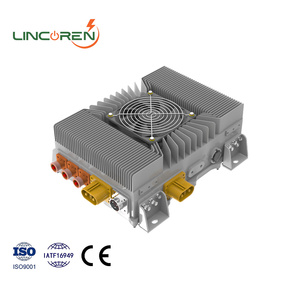
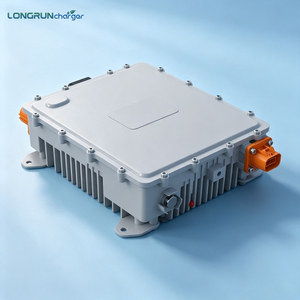
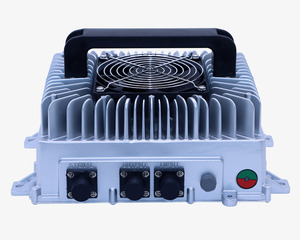
In modern e-Mobility platforms, power converters perform two primary functions: high-voltage to low-voltage step-down conversion (DC-DC) for auxiliary loads, and AC-to-DC grid power conversion (OBC) for traction battery replenishing. Advanced 2-in-1 integrated assemblies combine these functions into single IP67-sealed chassis, drastically reducing wiring harness complexity, weight, and volume.
1. Isolated High-Voltage to Low-Voltage DC-DC Converters
Electric commercial vehicles operate high-voltage traction battery packs ranging from 300VDC to 800VDC. However, legacy chassis components—such as power steering pumps, hydraulic lifts, ABS controllers, lighting, and HVAC fans—require steady 12V, 24V, or 48V low-voltage DC buses. NetPower's isolated DC-DC converters utilize zero-voltage switching (ZVS) and zero-current switching (ZCS) resonant topologies to achieve continuous output efficiencies of up to 96% while maintaining up to 2250VDC galvanic isolation between high-voltage traction batteries and sensitive low-voltage control electronics.
2. Bidirectional & High-Efficiency On-Board Chargers (OBC)
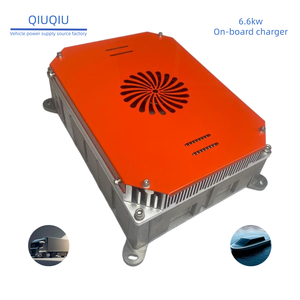
AC charging systems require onboard rectification and power factor correction (PFC). Modern 3.3kW, 6.6kW, and higher power OBC modules convert AC grid power (single-phase 110V/220V or 3-phase commercial supplies) into regulated DC voltage tailored to specific battery chemistries, including Lithium Iron Phosphate (LiFePO4) and Nickel Manganese Cobalt (NMC). Bidirectional OBC topologies further unlock Vehicle-to-Grid (V2G) and Vehicle-to-Load (V2L) capabilities, allowing municipal and utility fleets in provinces like Quebec and Ontario to feed power back into localized smart grids during peak demand hours.
Localized Application Scenarios Across Canadian Industries
The operational landscape across Canada demands specialized power topologies tailored to specific industrial sub-sectors. Below is a breakdown of localized deployment scenarios where NetPower converters deliver verified performance gains:
Underground Mining EVs
Deployed in Northern Ontario and Quebec hard-rock mines. Requires heavy vibration dampening, encapsulated IP67/IP69K enclosures, and high-voltage immunity against supply line transients.
Urban Transit & Municipal Fleets
Electric buses in Toronto, Montreal, and Vancouver. Focuses on 2-in-1 OBC and DC-DC assemblies, continuous 24/7 reliability, zero downtime, and real-time CAN bus telemetry logging.
Last-Mile Cold-Chain Delivery
Commercial courier vehicles operating across snowy routes. DC-DC converters power continuous thermal refrigeration units off the main traction pack without dropouts during rapid acceleration.
Off-Highway & Forestry Equipment
Heavy duty electrification in British Columbia's logging sectors. Modules feature potted encapsulation to resist extreme humidity, mechanical shock, and organic debris accumulation.
Canadian Market Trends & Regulatory Compliance Pathways
Developing electric vehicles for the Canadian market requires strict adherence to stringent technical standards and evolving environmental policies. Engineers must consider three prominent macro-trends currently shaping the sector:
1. Mandatory Sub-Zero Thermal Resiliency (-40°C to +85°C)
Standard off-the-shelf power modules designed for moderate climates often suffer from cold-start lockout, electrolyte degradation in internal filtering capacitors, and excessive output voltage drift when energized below -20°C. NetPower's vehicle-grade EV converter family incorporates automated thermal sensing and soft-start pre-heating routines, allowing seamless boot-up and stable full-load regulation down to -40°C ambient temperatures.
2. CSA Certification & Transport Canada Standards
Electrical safety compliance in Canada requires alignment with CSA C22.2 No. 107.1 (General Use Power Supplies) and UL 2202 / UL 2580 standards for electric vehicle supply equipment and battery safety. Furthermore, vehicle-level integration demands compliance with CISPR 25 Class 5 electromagnetic compatibility guidelines to prevent high-frequency switching noise from interfering with onboard GPS, telematics, and emergency radio frequencies.
3. Transition to High-Density Silicon Carbide (SiC) Topologies
To reduce space constraints within compact engine bays, Canadian EV OEMs are rapidly adopting Wide Bandgap (WBG) semiconductors, specifically Silicon Carbide (SiC) MOSFETs. SiC switches operate at significantly higher switching frequencies (up to 300kHz+) than traditional Silicon IGBTs. This allows power engineers to reduce the volumetric footprint of magnetic components (transformers and inductors) by over 40%, boosting overall power density to industry-leading levels above 3.0 kW/L.
Comprehensive Technical Specification Comparison Matrix
The table below provides system design engineers with a structural benchmark comparing standard board-mount DC-DC bricks against fully integrated vehicle-grade EV converter platforms suitable for Canadian commercial fleets:
| Parameter / Specification | Standard Industrial Bricks | Automotive EV DC-DC Modules | 2-in-1 OBC & DC-DC Integrated Assembly |
|---|---|---|---|
| Power Range | 15W to 1000W+ | 1kW to 5kW Continuous | 3.3kW / 6.6kW OBC + 1.8kW DCDC |
| Input Voltages (Nominal) | 9-36V, 18-75V, 36-75V | 180-400V, 300-500V, 400-650V | 85-265VAC (Grid) / 200-450VDC |
| Peak Efficiency | 91% - 94% | 95% - 96% | 95.5% (OBC) / 96% (DCDC) |
| Operating Temperature | -40°C to +100°C (Baseplate) | -40°C to +85°C Ambient | -40°C to +85°C Ambient |
| Cooling Methodology | Conduction / Airflow | Liquid Cooled / Air Cooled | Air Cooled / Liquid Cold-Plate |
| Ingress Protection | Open-frame / Encapsulated | IP67 Sealed Housing | IP67 / IP69K Waterproof |
| Control Interface | Analog Trim / Remote On-Off | CAN Bus 2.0B / J1939 | Isolated CAN Bus Communication |
| Galvanic Isolation | 1500 VDC - 2250 VDC | 3000 VAC / 4000 VDC | 3000 VAC (Input-Output) |
Enterprise Advantages: Why Canadian Engineering Teams Partner with NetPower
NetPower Technologies, Inc. brings decades of specialized design and manufacturing heritage to the global power electronics market. With millions of isolated DC-DC bricks and e-Mobility converters deployed worldwide, our technology platform provides Canadian OEMs with an unparalleled foundation of reliability and customization flexibility.
1. Rigorous Qualification & Zero-Defect Manufacturing
Every single power converter that leaves NetPower facilities undergoes a complete suite of automated screening protocols, including High-Accelerated Life Testing (HALT), High-Accelerated Stress Screening (HASS), full thermal burn-in, and 100% automated optical and electrical final testing. Our ISO 9001 and IATF 16949 certified quality management system guarantees lot-to-lot consistency and total raw material component traceability.
2. Scalable Modular Footprints (DOSA to Custom Modules)
Whether your design calls for standard DOSA-compliant brick footprints (1/32nd, 1/16th, 1/8th, Quarter, Half, and Full Brick) for low-voltage signal boards or fully customized extruded aluminum enclosures with integrated cooling liquid channels for 5kW heavy vehicle chassis, NetPower engineers work directly with your mechanical and electrical design teams to eliminate physical integration bottlenecks.
3. Direct Engineering Consultation & Rapid Customization
We believe that high-gain SEO information must be backed by real engineering responsiveness. Rather than routing technical inquiries through non-technical sales agents, Canadian clients receive direct support from senior switch-mode power supply (SMPS) design experts. From custom pinout layouts and firm-level CAN bus message tailoring to specialized conformal coating for severe condensation environments, NetPower offers NRE-efficient custom turnkeys.