1. Malaysia e-Mobility Dynamics & Tropicalized Power Conversion
Malaysia is experiencing a systemic acceleration in electric vehicle (EV) adoption, driven by the government's National Energy Transition Roadmap (NETR) and the Low Carbon Mobility Blueprint (LCMB) 2021-2030. With targets set to achieve 15% xEV total industry volume by 2030 and 38% by 2040, the Malaysian automotive sector—spanning Tier-1 assemblers in Shah Alam, Rawang, and Kulim—is actively seeking industrial-grade and automotive-certified e-Mobility power conversion systems. However, exporting and deploying power electronics in Malaysia requires addressing extreme operational conditions that off-the-shelf Western or standard temperate-climate power converters fail to withstand.
Key Information Gain: Thermal power derating models calibrated for Malaysia’s year-round ambient temperatures (32°C to 38°C) and extreme relative humidity (>85% RH) show that unsealed power electronics experience accelerated MTBF degradation by up to 340% due to moisture ingress and electrolytic corrosion. IP67 sealed liquid-cooled OBC & DC-DC modules mitigate this failure mechanism entirely.
To ensure 24/7 reliability in Malaysia’s tropical monsoon climate, our exported power conversion platforms incorporate full potting techniques with high thermal conductivity silicone, anti-corrosion marine-grade anodized aluminum enclosures, and dual-loop thermal management. Whether deployed in urban transit buses across the Klang Valley or electric delivery tricycles navigating torrential downpours in Penang, our power systems provide uncompromised voltage stability and thermal headroom.
Single & 3-Phase Grid Adaptation
Fully compatible with Malaysia’s Tenaga Nasional Berhad (TNB) 230V AC single-phase and 400V AC three-phase 50Hz grid distribution, equipped with active Power Factor Correction (PFC > 0.99).
IP67 / IP68 Tropical Ingress
Hermetically sealed internal electronics protected against severe water wading, flash floods, and high relative humidity prevalent during the East Coast and Southwest monsoons.
Wide DC Output Flexibility
Programmable charging profiles covering 48V, 72V, 144V, 312V, up to 400V nominal battery architecture, supporting LiFePO4, NMC, and LTO chemistries.
2. Advanced Topology: Bidirectional OBCs & Integrated 2-in-1 Power Packs
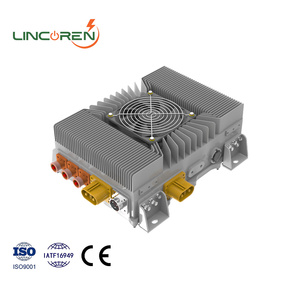
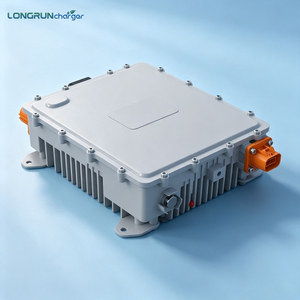
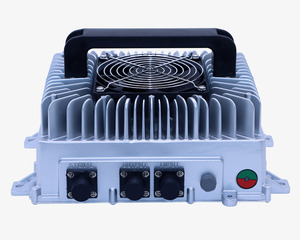
Modern commercial e-Mobility engineering is shifting away from discrete, standalone components toward tightly integrated power electronic assemblies. Our 3.3kW On-Board Charger (OBC) combined with 1.8kW DC-DC converter 2-in-1 modules represents the state-of-the-art in vehicular power distribution. By sharing cooling channels, digital signal processing (DSP) control cores, and structural housing, overall weight is reduced by 35% while power density is elevated above 2.2kW/L.
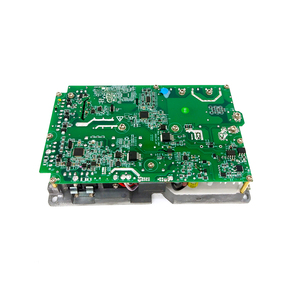
The primary power stage utilizes high-frequency Silicon Carbide (SiC) MOSFET switches operating in a resonant LLC topology. This delivers soft-switching zero-voltage transition (ZVT) characteristics, minimizing switching losses and achieving peak conversion efficiencies exceeding 96%. For the Malaysian commercial transport sector, this translates directly to reduced parasitic heat dissipation, smaller radiator volume requirements, and lower total cost of ownership (TCO).
| Technical Parameter |
3.3kW Industrial OBC Series |
3.3kW OBC + 1.8kW DC-DC 2-in-1 |
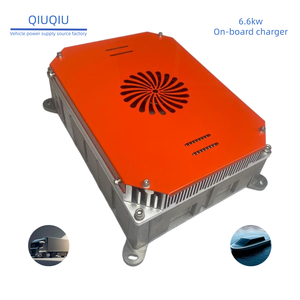
6.6kW Commercial OBC Platform |
| Input AC Voltage Range |
85V – 265V AC (Universal) |
85V – 265V AC (Universal) |
180V – 265V AC (High Power) |
| Nominal Output Voltage |
48V / 72V / 144V / 312V DC |
Main: 100-200V / Auxiliary: 13.8V |
200V – 450V DC (High Voltage) |
| Peak Conversion Efficiency |
> 95.0% |
OBC: 95.8% | DC-DC: 94.5% |
> 96.2% (SiC Architecture) |
| Power Factor (PFC) |
≥ 0.99 at full load |
≥ 0.99 at full load |
≥ 0.995 at full load |
| Cooling Method |
Forced Air / Cold Plate Liquid |
Liquid Cooled / Air Cooled |
Liquid Cooled (Glycol/Water 50:50) |
| Communication Protocol |
CAN 2.0B (Isolated 2.5kV) |
CAN 2.0B (Isolated 2.5kV) |
CAN 2.0B / UDS Diagnostic |
| Safety & Compliance |
IEC 61851, SAE J1772, SIRIM |
ISO 26262 ASIL-B, IATF 16949 |
IEC 61851, CE, UL2202, EN55032 |
The secondary high-voltage to low-voltage (HV-to-LV) DC-DC conversion stage reliably steps down high-voltage traction battery power to a regulated 12V/24V DC bus, supplying steering assistance, braking hydraulics, vehicle control units (VCU), and air conditioning blowers. Featuring fast dynamic load response (<2ms for a 50% load step), the module prevents low-voltage brownouts during heavy inductive surge loads.
3. Customized Localized Application Scenarios Across Malaysia
As an established exporter to ASEAN nations, our e-Mobility converters are optimized for distinct operating environments found across Peninsular Malaysia and East Malaysia (Sabah & Sarawak):
- Urban Electric Transit Buses (Prasarana & Rapid KL Networks): Heavy-duty 6.6kW and dual 3.3kW redundant OBC modules integrated into 12-meter e-buses. Designed to handle continuous high-power depot AC charging alongside frequent stop-and-go battery auxiliary loads in ambient city temperatures reaching 38°C.
- Last-Mile E-Commerce & Postal Delivery Fleets: Compact 3.3kW IP67 air-cooled chargers installed in light commercial electric vans and 3-wheel delivery vehicles operating in Kuala Lumpur, Petaling Jaya, and Johor Bahru. Resistant to severe road vibration and tropical downpours.
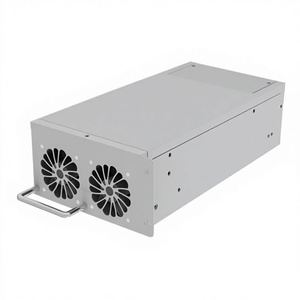
- Industrial Port Automation & Warehousing: Rack-mounted high-efficiency 3.3kW fast chargers utilized in automated guided vehicles (AGVs) and heavy electric forklifts at Port Klang, Port of Tanjung Pelepas (PTP), and industrial estates in Penang.
- Resort & Island Eco-Mobility: Encapsulated 48V/72V smart chargers powering electric golf buggies, resort shuttles, and light electric marine craft in Langkawi, Pangkor, and Redang Island, featuring complete protection against saline air corrosion.
4. Manufacturing Excellence, E-E-A-T Authority & Export Compliance
Our production facilities operate strictly under the IATF 16949 automotive quality management standard, ensuring that every converter shipped to Malaysian OEMs meets rigorous automotive-grade standards. We adhere to comprehensive design-for-reliability (DFR) protocols, subjecting 100% of manufactured units to automated optical inspection (AOI), full-load burn-in screening under elevated temperatures, and High-Accelerated Life Testing (HALT).
To streamline import processes for Malaysian buyers, our products comply with International Electrotechnical Commission (IEC) standards, enabling seamless SIRIM approval and Energy Commission (Suruhanjaya Tenaga - ST) clearance. Furthermore, our products qualify for preferential tariff treatments under the ASEAN-China Free Trade Area (ACFTA) Form E framework, minimizing import duty burdens for Malaysian importers and local CKD assemblers.
5. Frequently Asked Questions (FAQ) for Malaysian Procurement Engineers
Q1: How do your OBCs handle Malaysia’s grid voltage variations?
Our converters feature a wide AC input range (85V – 265V AC) with active PFC (Power Factor > 0.99), protecting internal circuitry against brownouts, grid surges, and phase imbalances common during heavy lightning storms in Malaysia.
Q2: Are these converters certified for SIRIM and ST approval in Malaysia?
Yes. Complete test reports covering IEC 61851-1 (EV charging standards), IEC 60950/62368 (safety), and EN 55032 (EMC) are provided, allowing local system integrators to secure SIRIM and Suruhanjaya Tenaga certifications efficiently.
Q3: Can the CAN bus protocol be customized for our local vehicle controller (VCU)?
Absolutely. We supply a fully documented CAN 2.0B database (DBC file) and offer firmware modification services to align message IDs, baud rates (250kbps/500kbps), and BMS handshake sequences with your specific vehicle architecture.
Q4: What thermal management strategy is recommended for Malaysia?
For high-duty cycle vehicles (e-buses, commercial trucks), we strongly recommend liquid-cooled IP67 modules connected to the vehicle's glycol radiator circuit. For light vehicles (buggies, 2-wheelers), our sealed air-cooled IP67 modules offer superior reliability without liquid pumps.
Q5: What is the typical shipping lead time to Port Klang or Penang Port?
Standard sample orders ship via express air freight within 7–10 working days. Commercial batch shipments via sea freight to Port Klang take approximately 12–15 days from factory release. Standard Form E documentation is provided for zero-duty tariff clearance.
Q6: Do you offer semi-custom mechanical footprint modifications?
Yes. We support semi-custom mechanical adaptations, connector type swaps (Amphenol, TE Connectivity, or custom wire harnesses), and mounting plate redesigns for OEM order volumes to ensure plug-and-play installation in your chassis space.
Accelerate Your e-Mobility Program in Malaysia
Partner with a trusted tier-1 manufacturer of high-efficiency On-Board Chargers and DC-DC Converters. Contact our engineering team today to request complete CAD files, datasheets, thermal models, and sample units for local prototyping.
Get Catalog