
Direct factory supply featuring galvanic isolation, wide input tolerance, and military-industrial grade noise suppression for medical, automotive, and industrial PLC control networks.
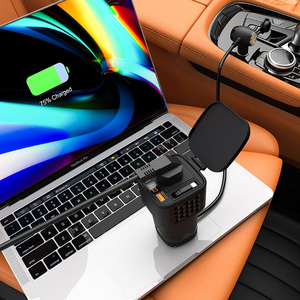
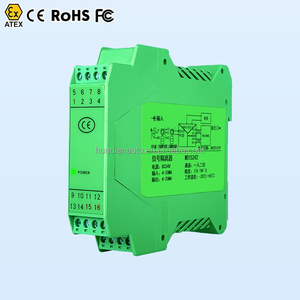
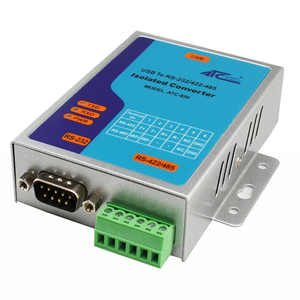
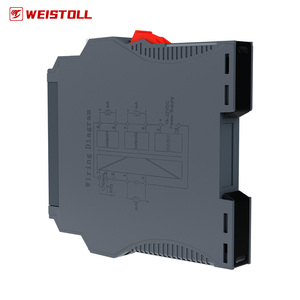
Standardization, thermal dissipation excellence, and rigorous manufacturing governance distinguish Tier-1 isolated converter manufacturers from commodity assemblers.
Full compliance with DOSA (Distributed-power Open Standards Alliance) footprint specifications including 1/32nd, 1/16th, 1/8th, Quarter, Half, and Full Brick forms, enabling frictionless drop-in replacement and modular expansion.
Leveraging Gallium Nitride (GaN) and Silicon Carbide (SiC) power switching elements to dramatically reduce magnetic losses, achieve power densities exceeding 100W/in³, and minimize thermal derating under ambient stress.
Proprietary planar transformer matrices providing up to 4000VAC or 2250VDC isolation ratings. Effectively eliminates ground loops, dampens common-mode noise, and shields sensitive MCU/DSP controllers from high-voltage spikes.
In contemporary power electronic systems, galvanic isolation stands as an indispensable safety and operational requirement. Whether converting power in high-voltage Electric Vehicle (EV) powertrains, stabilizing industrial Automation Controllers (PLC), isolating field sensors in processing plants, or managing intermediate bus architectures (IBA) in datacenters, isolated converters serve two vital purposes: breaking dangerous ground loops and protecting low-voltage logic circuits from severe transient faults.
Top trusted isolated converter factories and suppliers have evolved from basic analog switching houses into advanced R&D centers. Modern sourcing demands go far beyond simple voltage step-up or step-down functionality. Procurement officers and principal design engineers prioritize power density, ultra-wide input voltage ranges (such as 4:1 and 8:1 ultra-wide topologies accepting 9–36VDC, 18–75VDC, or 66–160VDC for railway compliance under EN 50155), lower parasitic capacitance, and high Mean Time Between Failures (MTBF).
Isolated power and signal converters rely on distinct isolation barriers depending on whether they transfer energy (power modules) or process data (signal conditioners). Understanding these architectural variations is essential for engineering sourcing teams:
For power levels ranging from 15W to over 1000W, isolated converters rely primarily on magnetic transformer coupling. High-frequency pulse-width modulation (PWM) drives primary switches—traditionally MOSFETs, and increasingly high-electron-mobility GaN transistors—to transfer energy across a planar transformer core. Secondary-side synchronous rectification is then employed to achieve field-proven efficiencies reaching 95% to 96%.
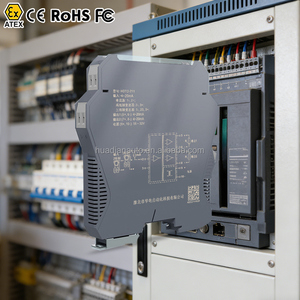
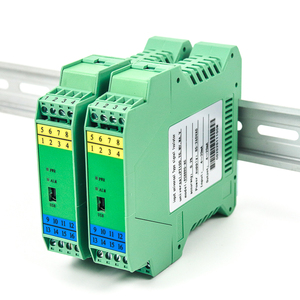
In low-power signal conditioning (e.g., 4–20mA, 0–10V, RS485, RTD/TC isolators), flyback or push-pull micro-transformers are embedded directly within encapsulated SIP/DIP modules or DIN-rail housings. This prevents high common-mode transient immunity (CMTI) degradation and ensures signal fidelity over long distances (up to 1.2km for industrial RS485 channels).
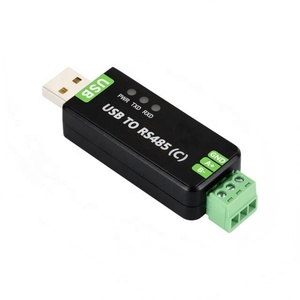
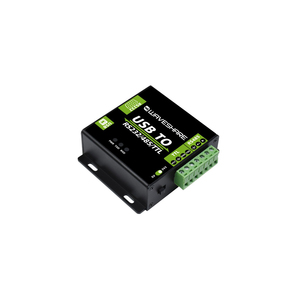
Industrial communication interfaces—such as USB-to-RS485, USB-to-RS232/422/TTL, and analog transmitter modules—utilize solid-state isolation barriers. Optocoupler-based isolation offers high voltage breakdown immunity, while modern digital isolators utilize high-frequency capacitive or micro-transformer silicon dies. This allows data rates up to 12 Mbps while maintaining TVS surge protection against 15kV ESD events and lightning-induced surges.
| Converter Category | Isolation Voltage | Typical Input Range | Primary Topology | Core Application Domain |
|---|---|---|---|---|
| Board-Mounted Bricks (1/16 to Full) | 1500VDC - 2250VDC | 18-36V, 36-75V, 180-400V | Full-Bridge / Active Clamp Forward | Telecom, Datacom, Cloud Servers |
| e-Mobility High Voltage Modules | 3000VAC - 4000VAC | 300-500VDC, 400-650VDC | Phase-Shifted Full Bridge (PSFB) / LLC | EV On-Board Chargers & Auxiliary DC-DC |
| Industrial Signal Isolators (4-20mA/0-10V) | 1500VAC - 3000VDC | 24VDC (18-32V), 5V USB | Optical / Capacitive Digital Coupling | PLC Analog I/O, Process Automation |
| Interface Converters (USB to RS485/232) | 1000VDC - 3000VDC | 5V Bus Powered / 12-24V Ext | Magnetically Coupled Transceiver + TVS | SCADA Systems, Fieldbus Maintenance |
As global industrial systems migrate toward Industry 4.0, decarbonization, and smart grid automation, isolated power conversion technology is experiencing several transformative trends:
Standard silicon MOSFETs are rapidly reaching their physical conduction and switching limit. Top-tier converter factories are refactoring their design platforms to incorporate GaN (Gallium Nitride) and SiC (Silicon Carbide) switches. These wide bandgap materials exhibit vastly superior breakdown electric field strength and significantly reduced gate charge, allowing switching frequencies to elevate from 100–300 kHz up to 1–3 MHz. The practical result for buyers is clear: smaller footprint components, smaller magnetic cores, and power density increases of up to 40% with zero loss in efficiency.
For high-reliability environments—such as sealed off-highway machinery, electric trucks, mining haulers, and high-altitude aerospace modules—fanless operation is mandatory. Sourcing trends favor encapsulated modules with integral aluminum baseplates or liquid-cooled cooling channels. Epoxy resin potted modules provide complete protection against humidity, salt spray, shock, and vibration, allowing operation across thermal spans from -40°C to +105°C ambient without premature derating.
Modern system architects demand real-time diagnostics. Advanced isolated DC-DC converters now incorporate digital control loops with PMBus, I2C, or CANbus interfaces. This enables system managers to monitor input voltage, output current, internal hot-spot temperatures, and fault histories remotely. Predictive failure algorithms can detect subtle performance shifts before a catastrophic system shutdown occurs.
When selecting an isolated converter factory or supplier, structural engineering evaluation must extend far beyond unit price. Below are critical qualification benchmarks used by world-class procurement teams:
A reputable manufacturer implements rigid Design for Reliability (DfR) protocols. Request documented proof of HALT (Highly Accelerated Life Testing) and HASS (Highly Accelerated Stress Screening) parameters. Standard thermal cycle testing should exceed 1,000 cycles from -40°C to +125°C. Component derating rules must adhere to NAVSO P-3641A or MIL-HDBK-217F standards, ensuring capacitors and semiconductors operate comfortably below maximum rated voltage and junction temperatures.
Verify whether the factory maintains ISO 9001 and IATF 16949 (for automotive line qualifications) certifications. Leading suppliers mandate 100% Automated Optical Inspection (AOI), 100% automated functional testing, and full lot-level material traceability. Every single module leaving the assembly line should possess a unique barcode tracking its raw silicon wafer batch, magnetic core origin, and automated burn-in test results.
Ensure that supplier product series hold native certifications for international safety standards, including UL 62368-1 (Information Technology and Audio/Video equipment standard replacing UL 60950-1), IEC/EN 61000-4 series for immunity against electrostatic discharge and surge spikes, CE declarations, and EN 50155 compliance for railway rolling stock systems.
Our featured manufacturing platforms represent decades of specialized switch-mode power supply (SMPS) design and precision manufacturing expertise. By bridging advanced circuit topology design with vertically integrated production lines, our partner facilities consistently deliver field-proven reliability across millions of deployed converters globally.
Engineers and sourcing specialists benefit from an extensive product portfolio spanning micro-power surface-mount isolated bricks (15W–50W), industry-standard DOSA-compliant telecom converters (100W–1000W+), robust signal isolation transmitters (4-20mA/0-10V), dynamic USB-to-Serial industrial adapters, and heavy-duty electric vehicle on-board chargers (OBCs up to 5kW). Whether your project requires off-the-shelf catalog units, semi-custom pinout modifications, or complete ground-up custom power architecture development, our dedicated application support teams ensure seamless prototype delivery and full volume production support.