
Explore our engineered power modules featuring high power density, IP67 sealed housings, wide DC/AC input ranges, and advanced CAN bus digital control protocols.
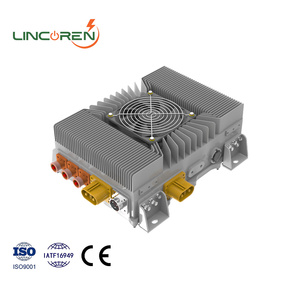
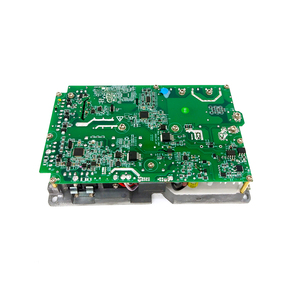
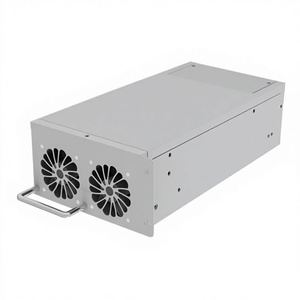
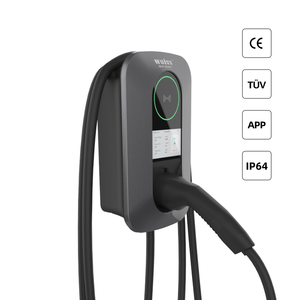
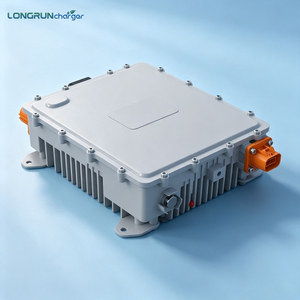
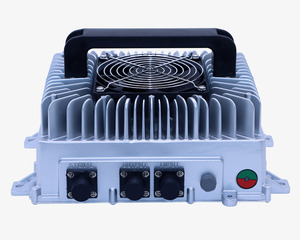
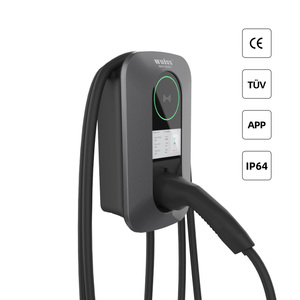
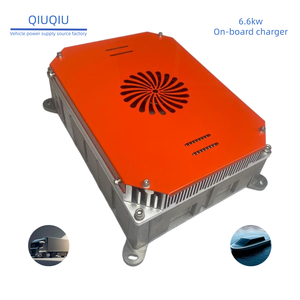
Backed by decades of switch-mode power conversion engineering, our automated manufacturing base produces high-density isolated bricks, non-isolated point-of-load (POL) modules, and IP67 bidirectional OBC assemblies designed for continuous operation in mission-critical applications.
In modern industrial automation, telecommunications infrastructure, railway systems, and e-Mobility platforms, power electronics represent the critical foundation of system thermal design and electrical integrity. A step converter—encompassing step-down (buck), step-up (boost), step-up/down (buck-boost), and isolated DC-DC power modules—serves as the voltage translation hub that steps down high bus voltages (e.g., 400V–800V EV traction battery buses, 48V telecom backplanes, or 110V railway lines) to tightly regulated secondary supply rails (e.g., 12V, 24V, 5V, 3.3V, or sub-1V processor cores).
China has established itself as the world’s premier manufacturing nexus for high-density power conversion hardware. Original Equipment Manufacturers (OEMs) and Original Design Manufacturers (ODMs) across North America, Europe, and Asia-Pacific increasingly turn to premier Chinese factories not merely for unit cost competitiveness, but for profound technological maturity, rapid engineering iteration, and robust supply-chain integration.
Information Gain Insight: The benchmark for tier-1 China step converter factories has transitioned from simple commodity assembly to advanced topologies incorporating Wide Bandgap (WBG) semiconductors (Silicon Carbide - SiC and Gallium Nitride - GaN), Zero-Voltage Switching (ZVS) resonant networks, DOSA footprint standardization, and digital CAN 2.0B / PMBus telemetry.
Selecting the optimal step converter architecture requires matching circuit topology to environmental constraints, safety isolation requirements, and dynamic load responses:
| Performance Dimension | Legacy Silicon (Si) Converters | Next-Gen SiC / GaN Step Converters | Procurement Impact |
|---|---|---|---|
| Switching Frequency | 50 kHz – 150 kHz | 300 kHz – 2.5 MHz | 70% Magnetics Reduction |
| Power Density | 15W – 30W / cubic inch | 80W – 250W / cubic inch | Smaller Footprint |
| Peak Efficiency | 88% – 92% | 95.5% – 97.2% | Lower Thermal Dissipation |
| Thermal Cooling | Bulky Forced Air / Heavy Heatsinks | Conduction Baseplate / Liquid Cooled | IP67 Sealed Compatibility |
| Control Interface | Analog Feedback Loop | Digital DSP with CAN BUS / PMBus | Real-Time Telemetry & OTA |
Our advanced China factory leverages automated Surface Mount Technology (SMT), planar transformer technology, and multi-stage testing to deliver high-yield power conversion modules.
Replacing wire-wound transformers with multi-layer printed circuit board (PCB) planar magnetics, reducing converter height profile to 1/32nd and 1/16th brick standards while enhancing thermal dissipation and repeatability.
Strict adherence to Distributed-power Open Standards Alliance (DOSA) pinout dimensions (micro-power, 1/32, 1/16, 1/8, quarter, half, full brick) guaranteeing drop-in, second-source compatibility for global telecom and datacom systems.
Potting and sealing technologies using thermal silica gel encapsulation protect electronic assemblies against severe shock, vibration, moisture ingress, and corrosive airborne contaminants in harsh off-highway and automotive environments.
Every step converter undergoes Automated Optical Inspection (AOI), 100% full-load electrical parameter testing, and HASS burn-in screening. Laser-etched QR codes link each serial number to raw material component batches.
From custom voltage conversion ratios, unique mechanical footprints, and specialized connector interfaces to customized CAN communication firmware, our R&D team executes full turn-key development within fast turnaround schedules.
Global procurement teams face shifting macroeconomic conditions, supply chain risks, and tightening energy efficiency regulations (such as EU Stage V emissions standards and 80 PLUS Titanium efficiency requirements). To maintain competitive advantage, technical buyers must align their step converter procurement strategy with four macro market trends:
Silicon MOSFETs are reaching theoretical performance limits regarding switching frequency and conduction losses. Next-generation step-down and step-up converters manufactured in China increasingly utilize Silicon Carbide (SiC) and Gallium Nitride (GaN) switches. GaN high-electron-mobility transistors (HEMTs) allow switching frequencies to scale beyond 1MHz, dramatically shrinking passive component volumes (inductors and capacitors). For global procurement managers, specifying SiC/GaN-based step converters yields lower total system cost by eliminating heavy heatsinks and expanding power output within existing mechanical enclosures.
In the commercial electric vehicle (EV), industrial forklift, and AGV (Automated Guided Vehicle) sectors, discrete power components are rapidly giving way to integrated power assemblies. Rather than procuring a standalone AC/DC On-Board Charger (OBC) and a separate DC-DC step-down auxiliary converter, buyers favor integrated 2-in-1 or 3-in-1 modules. These assemblies share common liquid or conduction cooling channels, high-voltage bus connectors, and digital control logic, yielding up to a 40% reduction in spatial volume and a 25% weight reduction.
As electronic component density increases on system boards, Electromagnetic Interference (EMI) mitigation becomes paramount. Leading China step converter factories invest heavily in internal 10-meter Anechoic EMC testing chambers to verify compliance with international standards including CISPR 32 / EN 55032 Class B for industrial products and CISPR 25 Class 4/5 for automotive assemblies. Furthermore, manufacturing facilities certified under IATF 16949 ensure that step converters withstand severe thermal cycling (-40°C to +125°C), shock, and humidity per AEC-Q200 standards.
To guard against global component shortages, top-tier Chinese manufacturers have built redundant raw material sourcing networks. Crucial components—including power ICs, magnetic cores, printed circuit boards, and thermal encapsulation compounds—are sourced through dual-qualified domestic and international supply channels. Procurement teams benefit from guaranteed multi-year production availability and minimized lead times even during peak market demand cycles.
Request full airflow vs. ambient temperature derating curves to ensure the module delivers full power at system operational limits without thermal shutdown.
Confirm hi-pot safety isolation ratings (1500VDC to 3000VDC) meet target market safety directives (UL 62368-1, EN 60950, IEC 60601).
Evaluate peak-to-peak output voltage ripple and dynamic step response recovery time under 25% to 75% step loads.
Ensure compliance with DOSA or standard pinout footprints (1/16, 1/8, quarter, half brick) for second-sourcing flexibility.
Verify ISO9001 / IATF 16949 certification, automated test coverage reports, and lot material traceability protocols.
Get immediate technical and commercial clarity regarding our step converter manufacturing capabilities, custom OEM options, sample lead times, and quality standards.