
High-efficiency, board-mounted DC-DC converters, non-isolated POL regulators, and automotive-grade EV charging solutions engineered for 24/7 reliability.
In modern electronic system design—spanning high-performance telecommunications, datacenter servers, industrial automation, AI hardware accelerators, and e-Mobility platforms—power architecture has shifted decisively from centralized power supplies to Distributed Power Architectures (DPA) and Intermediate Bus Architectures (IBA). At the core of this transition are Point-of-Load (POL) converters and high-density isolated DC-DC bricks.
A Point-of-Load (POL) converter is a non-isolated or isolated step-down DC-DC regulator positioned directly adjacent to the target load—such as FPGAs, ASICs, DSPs, microprocessors, and high-speed memory rails. By converting an intermediate bus voltage (typically 48V, 24V, or 12V) down to sub-volt or low DC voltages (e.g., 0.8V to 3.3V) at high output currents (ranging from 10A up to 100A+), POL regulators eliminate transmission line losses, reduce trace inductance, and maintain tight dynamic voltage regulation under extremely fast load transients.
Sourcing POL modules from top-tier Chinese original equipment manufacturers (OEMs/ODMs) like NetPower offers distinct advantages: access to DOSA-compliant standard pinouts, micro-encapsulated high-power-density designs, and custom firmware tuning for PMBus/CAN communication—all backed by ISO9001 and IATF16949 automotive-grade quality control systems.
When procuring from China's premier power converter factories, global buyers must evaluate manufacturers based on holistic engineering rigor—including dynamic loop response, thermal de-rating curves, conducted/radiated EMI suppression, and component de-rating guidelines, rather than mere top-line datasheet power ratings.
Explore the primary brick form-factors and non-isolated POL architectures designed for seamless integration into high-density printed circuit boards.
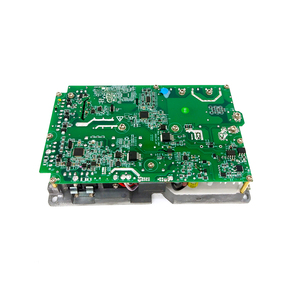
Designed strictly according to Distributed-power Open Standards Alliance (DOSA) guidelines. Available in SIP, DIP, and surface-mount (SMD) packaging with input ranges from 2.5V to 60V and currents up to 100A.
From micro-power 1/32nd and 1/16th bricks up to quarter, half, and full bricks delivering 15W to over 1000W. Features high dielectric isolation (up to 2250VDC) for telecommunications, railway, and aerospace.
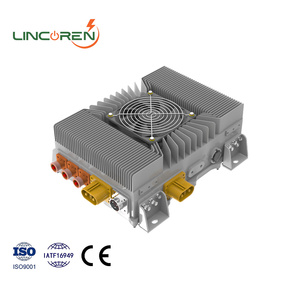
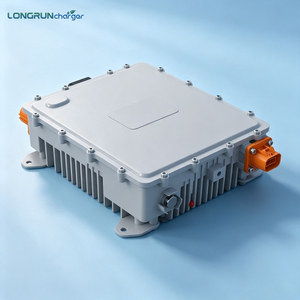
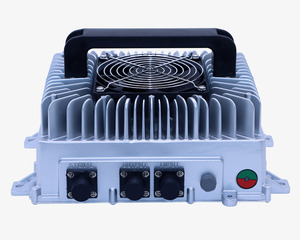
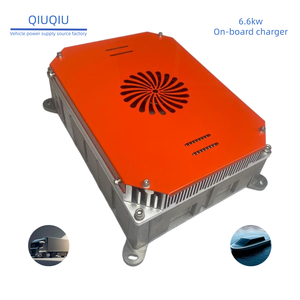
Heavy-duty, IP67 sealed, liquid- and air-cooled 2-in-1 assemblies integrating 3.3kW On-Board Chargers (OBC) with 1.8kW–5kW high-to-low voltage (HV to LV) DC-DC converters for electric vehicle fleets.
Below is a comparative breakdown of standard point-of-load and isolated board-mounted DC-DC brick footprints manufactured by leading Chinese power module suppliers:
| Footprint / Package | Typical Input Range (Vin) | Output Power / Current | Peak Efficiency | Target Applications |
|---|---|---|---|---|
| Non-Isolated DOSA POL | 2.5V – 14V / 18V – 60V | 6A to 100A (0.6V–5.5Vout) | 95.5% | FPGA, ASIC, Data Centers, Telecom Line Cards |
| 1/32nd & 1/16th Brick | 9V–36V / 18V–75V | 15W – 120W | 93.0% | Compact IoT, Robotics, Industrial Controllers |
| 1/8th Brick Isolated | 18V–75V / 36V–75V | 100W – 300W | 94.5% | 5G Base Stations, Network Switches, Routers |
| Quarter Brick Isolated | 9V–75V / 16V–160V Wide | 200W – 500W | 95.8% | Railway Rolling Stock, Heavy Machinery, Mil-COTS |
| Half & Full Brick | 180V–400V / 300V–650V HV | 500W – 1000W+ | 96.2% | High Voltage DC Grids, EV Chargers, Industrial Power |
| EV Integrated OBC+DCDC | 85V–265VAC / 200V–450VDC | 3.3kW OBC + 1.8kW DCDC | 96.0% | Electric Trucks, Buses, Off-Highway Commercial Vehicles |
As power densities escalate and circuit board real estate becomes increasingly constrained, power architects and global procurement teams face new demands. China's top POL converter factories are heavily investing in next-generation materials and topologies to stay ahead of global technology shifts:
Gallium Nitride (GaN) high-electron-mobility transistors (HEMTs) and Silicon Carbide (SiC) MOSFETs are replacing traditional Silicon switches. By enabling switching frequencies in the megahertz (MHz) regime, GaN-based POL converters drastically reduce the physical volume of magnetics (inductors and transformers) and output capacitors, unlocking power densities exceeding 300 W/in³.
With AI workloads, high-performance computing (HPC), and advanced graphics processing requiring hundreds of amperes at sub-1-volt levels, traditional 12V intermediate buses incur severe line losses ($I^2R$). The industry is rapidly standardizing on 48V Direct-to-Load conversion. Advanced Chinese manufacturers are producing single-stage matrix POL modules and Vertical Power Delivery (VPD) modules that mount directly underneath the processor socket to virtually eliminate PCB trace impedance.
Modern system control requires real-time monitoring of voltage, current, temperature, and fault status. Leading Chinese factories equip non-isolated POL and bus converters with digital control loops and PMBus v1.3 / CAN bus protocols, enabling dynamic output voltage scaling (AVS/DVS) and active load sharing across parallel modules.
To guarantee long-term field reliability, OEM design teams must audit prospective Chinese manufacturers against strict engineering and manufacturing metrics:
Verify component de-rating policies (e.g., operating ceramic capacitors within 50% rated voltage, junction temperature margins <105°C), thermal simulation verification, and worst-case loop stability analysis under temperature extremes.
Insist on 100% automated optical inspection (AOI), 100% automated final functional test, HALT/HASS stress screening, and lot-level component traceability from tier-1 semiconductor suppliers.
Ensure products carry UL/IEC/EN 62368-1 safety approvals, CISPR32 / EN55032 Class B EMI compliance data, ISO9001 quality management, and IATF16949 certification for automotive lines.
NetPower and top-tier Chinese power conversion specialists provide comprehensive capabilities tailored to global enterprise clients:
Get quick, authoritative answers to common engineering and sourcing questions regarding Point-of-Load modules and isolated DC-DC converters.
An isolated DC-DC converter uses a transformer to provide galvanic isolation between the input and output circuits (typically required for safety, ground loop elimination, or noise segregation). A non-isolated POL converter connects the input and output ground directly, utilizing a buck topology to deliver maximum efficiency, smaller footprint, and ultra-fast dynamic response near the semiconductor load.
DOSA (Distributed-power Open Standards Alliance) standardizes mechanical dimensions, pinout assignments, and control functions across manufacturers. Choosing DOSA-compliant POL converters ensures second-source availability, lowers supply chain risk, and allows drop-in replacements without requiring PCB layout redesigns.
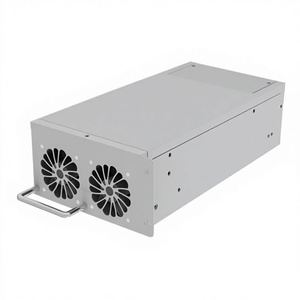
Selection depends on system enclosure constraints and ambient thermal environment. Air cooling (with integrated heatsinks and fans) suits open-frame indoor server/industrial racks. Conduction cooling (baseplate design) is ideal for sealed IP67 industrial boxes attached to cold plates. Liquid cooling is essential for high-power-density EV applications (such as 3.3kW–6.6kW OBCs and DCDC converters) where thermal dissipation demands exceed airflow limits.
Factory engineering teams can customize input/output voltage trim ranges, current limit thresholds, startup sequencing (tracking), mechanical enclosure dimensions, connector types, conformal coating formulations for severe environments, and digital communication protocols (PMBus, CANopen, SAE J1939).
Standard sample shipments include full electrical datasheet specifications, thermal derating curves across airflow speeds, recommended PCB layout guidelines, EMI filter circuit recommendations (for CISPR32 Class B compliance), and direct engineering support for loop compensation and system integration review.