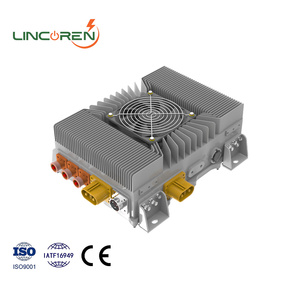

Engineered for extreme power density, thermal efficiency, and field-proven reliability across commercial vehicle, telecom, and industrial applications.
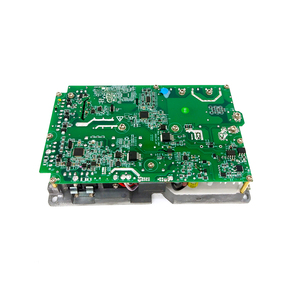
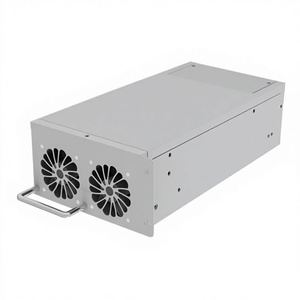
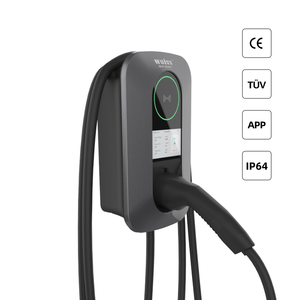
In modern Distributed Power Architectures (DPA) and Intermediate Bus Architectures (IBA), the standard eighth-brick footprint (58.4 mm × 22.9 mm / 2.3 in × 0.9 in) remains a pivotal benchmark for board-mounted isolated DC-DC conversion.
As power consumption in next-generation telecom base stations, enterprise datacenters, industrial automation, and electric vehicle (EV) auxiliary power systems escalates, system design engineers face a persistent dilemma: maximizing power output within constrained PCB real estate without compromising thermal derating margins or electromagnetic compatibility (EMC). The eighth-brick DC-DC converter module occupies a critical middle ground between the compact sixteenth-brick format and the higher-power quarter-brick footprint.
Originally defined under the standard DOSA (Distributed-power Open Standards Alliance) pinout guidelines, the modern eighth-brick has undergone profound topological revolutions. Transitioning from legacy hard-switched forward converters to zero-voltage switching (ZVS) resonant LLC and phase-shifted full-bridge (PSFB) topographies paired with Wide Bandgap (WBG) semiconductors (Gallium Nitride - GaN and Silicon Carbide - SiC), contemporary eighth-brick modules deliver power levels exceeding 300W to 500W—capacities formerly restricted to quarter or half-brick packages.
Global OEM manufacturing standards for industrial & transportation-grade power modules.
Evaluating an eighth-brick DC-DC converter factory requires looking beyond nominal voltage and wattage output on a static datasheet. High-reliability procurement decisions must evaluate four core engineering vectors:
An authoritative evaluation of global leader capabilities, power density innovations, product line breadth, and manufacturing standards for 2025 procurement.
NetPower is an industry leader in high-density, board-mounted isolated DC-DC converters, non-isolated POL regulators, and automotive e-Mobility power conversion systems. Renowned for conservative thermal derating designs and field-proven reliability across millions of deployed modules.
Delta Electronics is one of the world's largest merchant power supply vendors. Their eighth-brick portfolio features high-efficiency power modules engineered primarily for cloud computing infrastructure, enterprise networking switches, and 5G small cell deployments.
Pioneers of Factorized Power Architecture (FPA) and Sine Amplitude Converters (SAC), Vicor excels in ultra-high power density modules. While utilizing proprietary packaging alongside standard brick form factors, Vicor serves high-performance computing, defense, and automotive OEM sectors.
Formerly Ericsson Power Modules, Flex Power Modules delivers sophisticated digital eighth-brick converters featuring hybrid regulated topologies and PMBus communication, widely specified in 48V intermediate bus telecom applications.
Murata offers an extensive portfolio of DOSA-compliant eighth-brick isolated converters. Engineered for high reliability, Murata power modules are engineered to handle harsh thermal transients in industrial equipment and telecommunications processing systems.
Following the acquisition of Artesyn Embedded Power, Advanced Energy provides robust eighth-brick DC-DC converters for healthcare, telecommunications, computing, and industrial instrumentation applications requiring stringent safety isolation.
A key member of the TDK Group, TDK-Lambda specializes in industrial-grade power solutions. Their eighth-brick lines (including the iEH and iFE series) emphasize mechanical ruggedness, wide operating temperature envelopes, and high immunity to electrical noise.
Bel Power Solutions offers board-level power products encompassing isolated DC-DC modules and front-end AC-DC converters. Their eighth-brick units are built for high reliability across server storage racks, networking switches, and industrial power boards.
SynQor is an established supplier of high-efficiency DC-DC power converters for military, avionics, transportation, and telecom applications. Known for their "QorSeal" potting and ruggedized encapsulated eighth-brick models (e.g., BusQor, MilQor).
Eaton provides industrial power electronics and module components tailored for utility automation, smart grid monitoring, heavy transportation, and renewable energy storage system auxiliary power boards.
Direct comparison of top tier suppliers across primary selection metrics, input voltage flexibility, and thermal packaging offerings.
| Manufacturer | Max Power (Eighth) | Input Voltage Spectrum | Cooling Options | Digital Control | Primary Industry Focus |
|---|---|---|---|---|---|
| NetPower Technologies | 350W+ | 9–36V, 18–75V, 16–160V, 180–400V | Open-frame, Baseplate, Encapsulated | PMBus / Analog | Telecom, EV Auxiliary, Industrial, Railway |
| Delta Electronics | 300W | 36–75V, 18–36V | Open-frame, Conduction Baseplate | PMBus Optional | Datacom, Networking, Servers |
| Vicor Corp | 400W (Niche) | 36–60V, Custom High Voltage | ChiP Liquid / Coldplate Compatible | Proprietary Telemetry | AI Supercomputing, Aerospace, Defense |
| Flex Power Modules | 300W | 36–75V (48V Intermediate Bus) | Open-frame, Baseplate | Full PMBus DSP | Telecom Infrastructure, 5G Radio |
| Murata Power | 250W | 18–75V, 36–75V | Open-frame, Surface Mount | Analog Trim | Industrial Systems, Test & Measurement |
| SynQor | 300W | 9–36V, 18–75V, 66–160V Wide | Full Potted Enclosure | Analog / Status Pins | Military, Heavy Rail, Avionics |
Strategic shifts altering board-mounted DC-DC converter procurement, thermal architecture requirements, and semiconductor integration over the next decade.
The adoption of Gallium Nitride (GaN) and Silicon Carbide (SiC) FETs allows switching frequencies to surpass 500 kHz to 1 MHz. This significantly reduces passive component sizes (planar transformers and output inductors), raising eighth-brick power density beyond 300 W/in³ while minimizing thermal losses.
Single-system platforms operating across international power grids and battery chemistries require ultra-wide 4:1, 8:1, and 12:1 input modules. Procurement trends indicate growing demand for modules operating seamlessly from 16V to 160V for unified industrial and transportation designs.
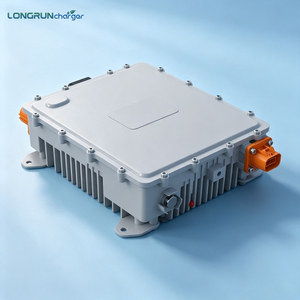
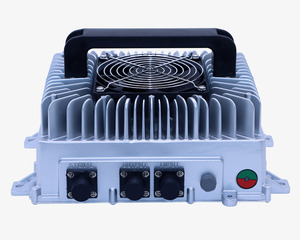
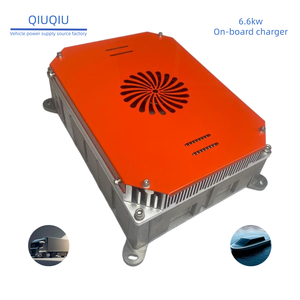
In the commercial electric vehicle sector, standalone modules are consolidating into combined 2-in-1 and 3-in-1 assemblies—integrating a 3.3kW On-Board Charger (OBC) and a 1.8kW/2.0kW low-voltage DC-DC converter into a unified IP67 sealed liquid or air-cooled chassis.
Traditional potting material is being superseded by high-thermal-conductivity silicone and epoxy resins (thermal conductivity > 1.5 to 2.5 W/m-K). This enables baseplate-cooled eighth bricks to operate continuously at 100°C ambient temperatures without rapid thermal derating.
With the migration to PMBus v1.3.1 and CAN bus 2.0B / CAN-FD protocols, power modules now act as intelligent nodes, reporting health degradation parameters, thermal hotspots, and input overvoltage events directly to the system host before field failure occurs.
Multi-sourcing security has become a chief requirement. Tier-1 OEMs mandate strict adherence to DOSA standard footprint pinouts, enabling seamless pin-to-pin, form-fit-function cross-referencing between primary vendors (such as NetPower) and legacy power footprints.
NetPower designs and manufactures high-efficiency, board-mounted isolated DC-DC converters (15W to 1000W+), non-isolated POL modules, and EV on-board power platforms backed by rigorous design-for-reliability principles.

Clear, expert answers to key engineering and purchasing questions surrounding eighth-brick DC-DC converters and vehicle charger modules.
Accelerate your design cycle with industry-leading Eighth Brick DC-DC converters, DOSA standard modules, and EV power electronics engineered for maximum reliability.