China has become a major manufacturing base for electric vehicle power electronics. Its suppliers produce converters for passenger cars, buses, commercial fleets, and charging equipment. This guide examines China’s leading e-Mobility Power Converters manufacturers through practical and technical criteria. The focus is not simply on company size or export volume. It considers conversion efficiency, thermal control, electromagnetic compatibility, software integration, and long-term field support.
Reliable evaluation requires more than reading product brochures. Engineers should review test data, operating temperature ranges, cooling methods, ingress protection, and high-voltage safety procedures. A converter may perform well in a laboratory but struggle under heavy loads, vibration, dust, or repeated fast charging. Factory audits can reveal production discipline, traceability, and inspection depth. Certifications also matter, but they should support verification rather than replace it.
The strongest manufacturers usually demonstrate experience across real vehicle platforms. They can explain how their designs manage heat near the battery pack or reduce losses during regenerative braking. Clear failure analysis is another useful signal. Suppliers that discuss limitations openly often appear more dependable than those promising perfect performance. That judgment is not always easy.
This overview compares technical capabilities, customization options, manufacturing quality, delivery consistency, and after-sales responsiveness. It also considers whether suppliers support validation, prototype development, and global compliance requirements. Market rankings can change quickly as technologies and partnerships evolve. Therefore, readers should treat this guide as a structured starting point, not a final purchasing decision. Direct testing remains essential.
E-mobility power converters manage electrical energy inside electric vehicles. They change voltage, current, or electrical form for different systems. A battery may store high-voltage DC, while a motor needs controlled three-phase AC. An inverter performs that conversion with precise switching. A DC-DC converter supplies stable low voltage to lights, sensors, and control units.
An onboard charger converts grid AC into battery-friendly DC. It may include power-factor correction, isolation, cooling, and communication controls. During a technical inspection, engineers check efficiency, switching noise, insulation, and heat around the power modules. A converter can appear efficient on paper but perform differently inside a hot, crowded vehicle. Thermal design matters greatly. Small details matter.
Manufacturers in China commonly develop converters for passenger vehicles, buses, charging equipment, and specialty mobility platforms. Reliable suppliers normally provide electrical curves, protection limits, test records, and clear operating conditions. Buyers should examine peak power, continuous power, input range, cooling method, ingress protection, and communication compatibility. The distinction between a charger and a converter is not always clean. Some integrated units combine several functions. That saves space, but it can complicate maintenance and failure analysis. Engineers should question optimistic efficiency figures. Real roads are less predictable.
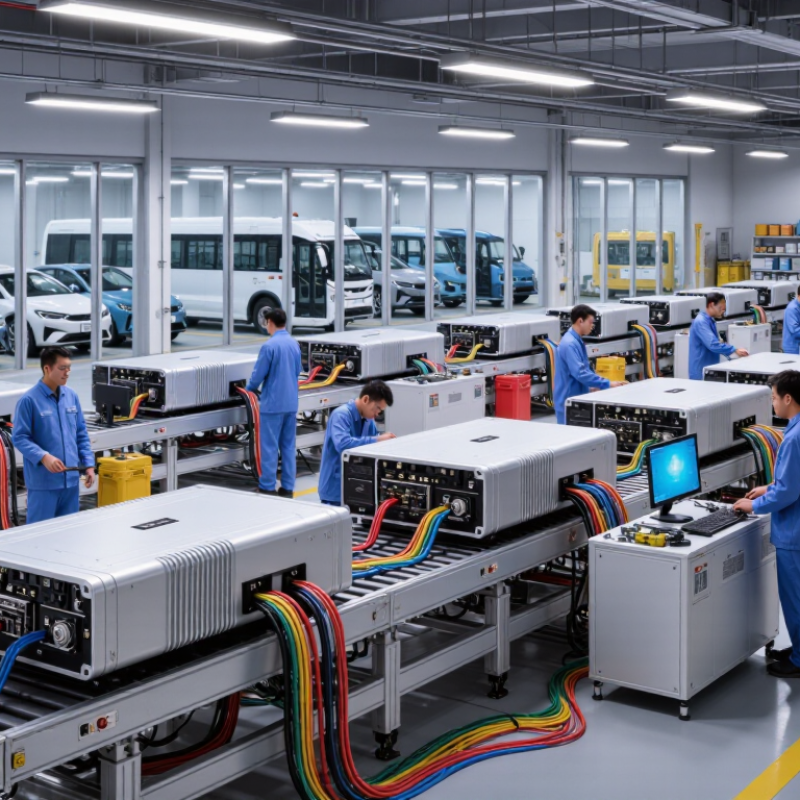
China’s e-mobility power converter industry is expanding through strong engineering capacity and a dense electronics supply chain. Manufacturers develop onboard chargers, DC-DC converters, traction inverters, and charging modules for passenger vehicles, buses, and commercial fleets. Production often combines automated assembly with manual inspection. That balance can improve consistency, but it is not flawless.
Real performance depends on thermal design, electrical isolation, control software, and long-term testing. During a technical audit, engineers may inspect solder joints, connector sealing, insulation resistance, and cooling-plate contact. A converter can pass a short laboratory test yet struggle after months of vibration, dust, and temperature changes. This is where experience matters. Some test reports remain too general, and buyers should ask for measured data rather than attractive claims.
Tips: Request efficiency curves across different loads. Check peak power, continuous power, standby consumption, and cooling requirements. Review protection functions, communication protocols, traceability, and failure records. Ask whether testing covers high humidity, salt exposure, vibration, and repeated thermal cycling. Do not rely only on samples. Pilot batches can reveal noise, connector heating, or software faults that small tests miss. Standards are important, but practical vehicle integration matters more. A careful supplier should explain limitations clearly, even when the answer is inconvenient.
China’s annual new energy vehicle sales increased from 1.37 million units in 2020 to 12.87 million units in 2024. This rapid expansion indicates growing demand for onboard chargers, DC-DC converters, traction inverters, and other power-conversion systems used across electric mobility.
Data source: China Association of Automobile Manufacturers (CAAM), annual new energy vehicle sales.
China Top e-Mobility Power Converter Manufacturers?
Chinese power converter manufacturers usually fall into several technical groups. Some focus on onboard chargers, converting grid electricity for vehicle batteries. Others produce DC-DC converters, which supply stable low-voltage power to lighting, control units, and safety systems. High-voltage inverters serve traction motors and require precise thermal control. These product differences matter more than factory size.
Another group develops fast-charging power modules for public charging equipment. Their strengths often include compact layouts, liquid cooling, and modular maintenance. Integrated suppliers combine chargers, DC-DC units, and power distribution functions in one enclosure. This can save installation space, but it may increase repair complexity. Custom manufacturers build converters for buses, delivery vehicles, construction equipment, or battery storage systems. Their engineering teams must understand unusual voltage ranges and harsh operating conditions.
Reliable evaluation requires more than reviewing a product brochure. Check conversion efficiency at partial load, insulation performance, electromagnetic compatibility, and protection responses during voltage changes. Ask for traceable test records and production samples. Factory audits should examine calibration tools, aging-test stations, and incoming component controls. A low quotation can hide limited testing depth. That is easy to overlook.
Some specifications still look impressive but lack field evidence. Engineers should request thermal images, failure-rate data, and service procedures. One practical concern remains: customized designs may perform well in trials yet become difficult to update later. Clear software ownership, spare-part planning, and documented quality changes deserve equal attention.
China’s e-mobility power converter manufacturers are advancing through practical power electronics innovation. Key technologies now shape efficiency, safety, and vehicle range.
Silicon carbide switches support higher voltage operation and lower switching losses. They also reduce cooling demands in traction inverters and onboard chargers. Gallium nitride devices can operate at higher frequencies in selected low and medium-power applications. Higher frequency allows smaller transformers, inductors, and electromagnetic filters. However, faster switching can increase electromagnetic interference. Engineers must control layout, gate timing, shielding, and grounding carefully.
Bidirectional converters enable energy flow between the battery, motor, charger, and external grid. This supports regenerative braking and vehicle-to-load functions. Digital control systems adjust current and voltage within microseconds. Reliable firmware also monitors insulation, temperature, overcurrent, and battery conditions. Thermal paths need copper layers, interface materials, and stable cooling channels. A small sensor error can still create a serious protection problem. Testing therefore combines laboratory measurements, road simulation, vibration checks, and long-duration temperature cycling.
High power density remains a difficult target. A compact converter may produce less heat, yet service access can become harder. Engineers sometimes optimize efficiency while overlooking repair time. That choice deserves more reflection. Robust designs balance switching performance, component life, cybersecurity, and manufacturing consistency. Field data should guide revisions, not only laboratory results. Practical validation builds confidence in converters used under rain, dust, traffic delays, and repeated fast charging.
| Converter Category | Primary Function | Common Semiconductor Technology | Typical Voltage Range | Typical Power Range | Typical Peak Efficiency | Key Topology or Control Method | Typical E-Mobility Use |
|---|---|---|---|---|---|---|---|
| On-Board Charger (OBC) | Converts AC grid power into regulated DC power for traction-battery charging | Silicon MOSFETs, silicon carbide MOSFETs, and silicon carbide diodes | AC input: 85–265 V; battery output: approximately 250–950 V DC | 3.3–22 kW for passenger vehicles; higher ratings for commercial vehicles | Approximately 94–98% | Totem-pole or bridgeless PFC followed by an LLC or phase-shifted full-bridge converter | Battery electric vehicles, plug-in hybrid vehicles, electric vans, and buses |
| DC-DC Converter | Steps high-voltage battery power down to low-voltage auxiliary power | Silicon MOSFETs for conventional designs; silicon carbide devices for high-voltage platforms | High-voltage input: approximately 200–950 V; low-voltage output: 12 V or 24/48 V | 1–3 kW in passenger vehicles; up to approximately 5–10 kW in larger platforms | Approximately 92–97% | Isolated LLC, phase-shifted full bridge, or interleaved buck conversion | 12 V or 48 V electrical systems, lighting, infotainment, pumps, and control units |
| Traction Inverter | Converts battery DC into controlled three-phase AC for the traction motor | Silicon IGBTs, silicon MOSFETs, or silicon carbide MOSFET modules | DC-link voltage commonly ranges from 250–950 V | 30–300 kW for passenger vehicles; higher ratings for heavy-duty vehicles | Approximately 95–99% | Two-level or three-level voltage-source inverter with field-oriented control and space-vector PWM | Permanent-magnet synchronous motors, induction motors, and switched-reluctance motors |
| Wireless Power Transfer Converter | Transfers electrical energy across an air gap without a physical connector | Silicon MOSFETs, silicon carbide MOSFETs, and high-frequency gate-driver systems | Typically 85–500 V DC on the vehicle side | 3.7–22 kW for stationary charging applications | Approximately 85–94%, depending on alignment and air gap | Resonant compensation networks such as series-series or LCC compensation | Passenger vehicles, automated parking chargers, and fleet depots |
| Bidirectional Charger | Enables both grid-to-vehicle charging and vehicle-to-grid or vehicle-to-home discharge | Silicon carbide MOSFETs and high-voltage silicon MOSFETs | Approximately 200–950 V DC battery-side voltage | 3.3–22 kW for AC bidirectional charging; higher power is possible with DC systems | Approximately 93–98% | Four-quadrant active front end combined with an isolated bidirectional DC-DC stage | Vehicle-to-grid, vehicle-to-home, backup power, and energy management |
| Integrated Drive Module | Combines the inverter, motor control, gearing, and sometimes DC-DC conversion in one assembly | Silicon carbide power modules or compact silicon IGBT modules | Approximately 400–950 V DC | 50–250 kW for passenger-vehicle drive units | Approximately 95–98% | High-frequency PWM, field-oriented control, compact busbar design, and direct liquid cooling | Electric passenger vehicles, performance vehicles, and commercial platforms |
| Auxiliary Inverter | Supplies variable-frequency AC power to electric compressors, pumps, fans, and steering systems | Silicon MOSFETs, IGBTs, and compact power integrated modules | Typically 12–800 V DC, depending on the auxiliary load | 0.2–15 kW per auxiliary motor or subsystem | Approximately 90–97% | Three-phase bridge inverter with sensorless or sensored motor control | Electric air-conditioning compressors, coolant pumps, oil pumps, and electric power steering |
| Fuel-Cell DC-DC Converter | Regulates variable fuel-cell output and connects it to the vehicle DC bus | Silicon carbide MOSFETs or high-current silicon IGBTs | Input often approximately 200–600 V; output commonly 400–950 V DC | 30–200 kW for fuel-cell electric vehicles | Approximately 95–98% | Interleaved boost, phase-shifted full bridge, or modular multilevel conversion | Fuel-cell buses, trucks, commercial vehicles, and long-range mobility platforms |
Selecting a Chinese power converter manufacturer requires more than comparing quotations. Check whether the factory understands your vehicle’s voltage range, cooling method, and communication protocol. Request recent test records for efficiency, thermal rise, insulation resistance, and electromagnetic compatibility. During a site visit, inspect assembly lines, calibration tools, and component traceability. A clean showroom proves little.
Ask for production samples from the same line used for volume orders. Connect the converter to a battery simulator and record current ripple, CAN responses, and shutdown behavior. Test it inside a thermal chamber if possible. Review protection functions for overvoltage, short circuits, overheating, and reverse polarity. Independent laboratory reports add confidence, but verify their model numbers and test dates. Documents can be incomplete.
Supplier evaluation should also cover engineering depth and after-sales response. Who investigates a field failure? How quickly can they provide a root-cause report? Clarify firmware control, tooling ownership, minimum order quantities, warranty terms, and change-notification procedures. I have learned that fast replies do not always mean strong support. A factory may promise customization, yet struggle with one revised connector. Leave time for pilot production, repeated validation, and corrective actions. The cheapest offer may hide testing gaps, unstable components, or expensive delays.
It manages electrical energy inside an electric vehicle. It changes voltage, current, or electrical form for different systems. Small details matter.
An inverter changes battery DC into controlled three-phase AC for the motor. A DC-DC converter supplies stable low voltage to lights, sensors, and control units. An onboard charger changes grid AC into battery-friendly DC.
Compare peak power, continuous power, input range, cooling method, and ingress protection. Also check standby consumption and communication compatibility. Paper figures can mislead.
Connect production samples to a battery simulator. Record efficiency, current ripple, communication responses, and shutdown behavior. Test samples under heat when possible.
Review protection against overvoltage, short circuits, overheating, and reverse polarity. Check insulation resistance and electrical isolation. Ask for measured limits.
A converter may perform well in a laboratory but struggle inside a hot vehicle. Engineers should inspect cooling-plate contact and temperature rise. Heat finds weak points.
Inspect assembly lines, calibration tools, solder joints, connector sealing, and component traceability. A clean showroom proves little. Documents can be incomplete.
Pilot batches can reveal connector heating, electrical noise, vibration damage, or software faults. Small tests may miss these problems. Repeated validation takes time.
Ask who investigates field failures and how quickly they provide root-cause reports. Clarify firmware control, warranty terms, tooling ownership, and change notifications. Fast replies are not always strong support.
Not necessarily. A low quote may hide testing gaps, unstable components, or costly delays. I would question attractive efficiency claims. Maybe I am too cautious.
E-Mobility Power Converters are essential components in electric vehicles and charging systems, converting electrical energy between different voltage, current, and frequency levels. They support functions such as battery charging, motor control, onboard power management, and energy recovery. China has developed a broad manufacturing ecosystem in this field, supported by strong electronics production capabilities, engineering expertise, and growing demand for electric transportation. Its industry includes manufacturers specializing in onboard chargers, DC-DC converters, traction inverters, charging modules, and integrated power systems.
Key technologies include high-efficiency semiconductor devices, advanced thermal management, compact circuit design, intelligent control systems, electromagnetic compatibility, and reliable protection mechanisms. When evaluating a Chinese manufacturer, buyers should consider technical capability, product efficiency, safety certifications, quality-control procedures, customization capacity, production scale, testing facilities, delivery reliability, and after-sales support. A thorough assessment of engineering resources and communication standards can help companies select a dependable partner and develop efficient, safe, and scalable e-mobility power solutions.